In Sub-Saharan Africa, access to electricity remains a significant challenge, particularly in rural areas where agriculture is the primary economic activity.
As of 2021, only 30.4% of the rural population in Sub-Saharan Africa had access to electricity, compared to 80.7% in urban areas.
This disparity leaves approximately 600 million people without electricity, with the majority residing in rural regions.
The lack of reliable energy sources severely impacts agricultural productivity.
Without access to electricity, farmers are unable to utilize modern irrigation systems, operate machinery for planting and harvesting, or power processing facilities.
This limitation results in reduced crop yields, increased post-harvest losses, and diminished food security.
For instance, a study by the World Resources Institute highlights that energy access can improve agricultural productivity, thereby enhancing food security and creating jobs for the two-thirds of the population that depend on agriculture for livelihoods.
Innovative solutions are essential to address this energy deficit and promote sustainable development.
Biomass gasification stands out as an innovative technology with immense potential.
The Blue Flame Biomass Stove—which has already revolutionized cooking in rural and semi-urban Africa—now takes a bold step forward with the development of a biomass gasifier aimed at electricity generation.
A Cleaner, Greener Future
Biomass gasification is the process of converting organic materials, such as agricultural waste, into a usable form of energy.
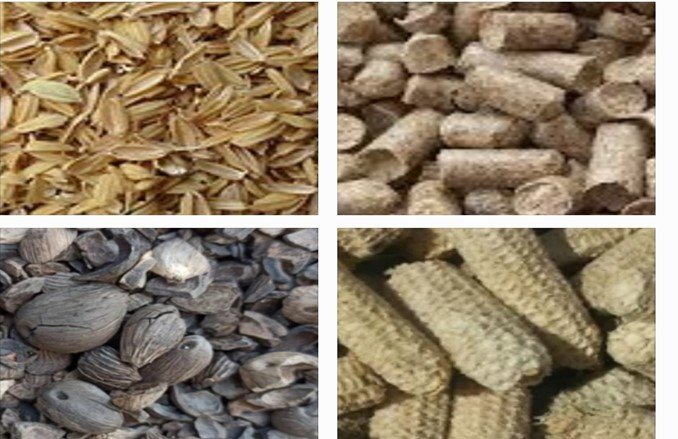
Through this process, farm residues like rice husks, kernel shells, and other agricultural byproducts are transformed into syngas, a mixture of hydrogen, carbon monoxide, and methane.
This syngas can be used to generate electricity with minimal environmental impact.
With deforestation rates increasing due to the high demand for firewood and charcoal, and electricity access still a challenge in many parts of the world, the need for affordable and environmentally friendly alternatives has never been greater.
Biomass gasification technology offers a way to address both challenges by utilizing waste materials to produce clean energy.
How It Works
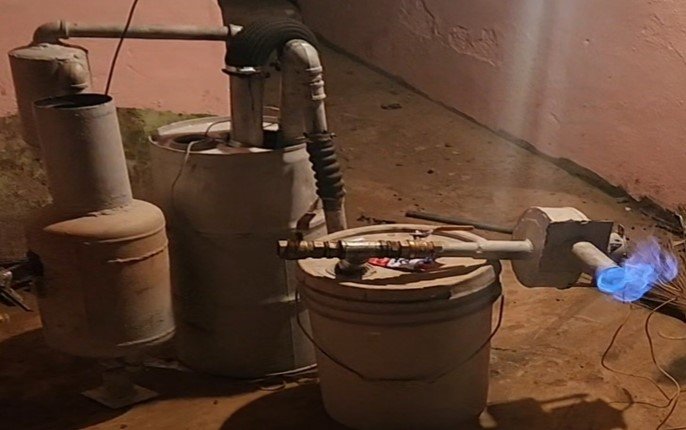
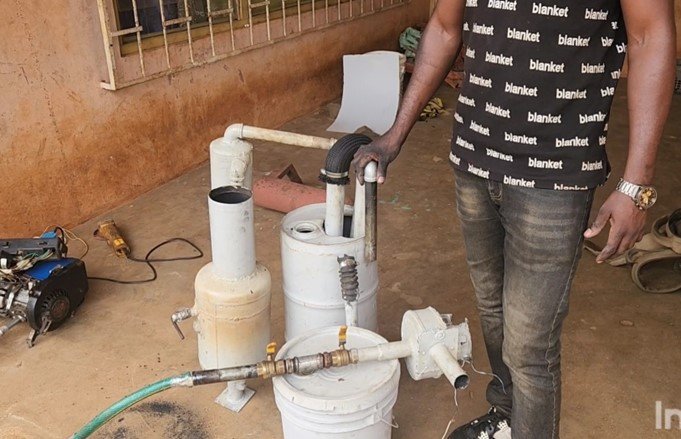
The Blue Flame Biomass Gasifier operates on a simple yet highly effective principle.
Agricultural waste is fed into a gasifier where it undergoes a high-temperature process in the presence of limited oxygen, converting it into syngas.
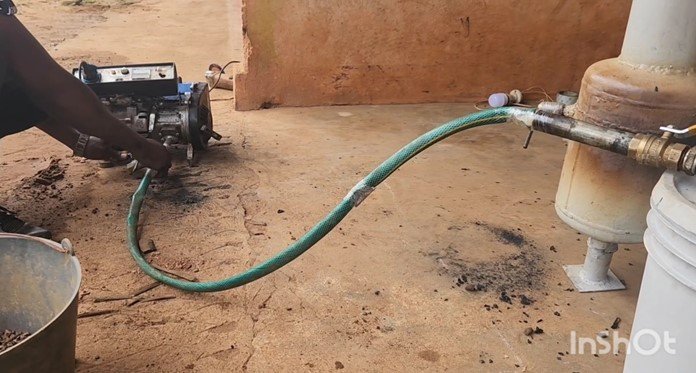
This syngas is then used to fuel a generator, which produces electricity.
The gasifier is equipped with a 35-watt air blower to maintain optimal combustion conditions.
Once the system is connected to the engine or generator, the blower is disconnected, allowing the system to run autonomously and ensuring a seamless transition to electricity generation.
Key Features and Benefits
1. Portable and Affordable: Units can be built at one-fourth the cost of solar power systems, making them an accessible solution for rural and off-grid communities.
2. Energy Independence for Farmers: Allows farmers to utilize locally available biomass to produce electricity and fuel for various applications.
3. Fuel for Farm Machines: The syngas produced can power tractors and other farm machinery, reducing dependence on expensive diesel.
4. Local, Low-Cost Technology: Based on locally sourced materials and components, making it a cost-effective and sustainable solution.
5. Scalable: The technology can be scaled from small 1 kW units to larger 100 kW units, adaptable for both small households and larger agricultural operations.
6. Quick Gas Production: Produces clean syngas in just three minutes after ignition, ensuring a fast and reliable energy source.
7. Clean Energy: Burns with little to no soot or smoke, significantly reducing indoor air pollution.
8. Cost-Effectiveness: Generates electricity from materials already available, significantly lowering household energy costs.
9. Energy Independence: Provides a renewable and reliable source of electricity that can power homes, small businesses, or community centers.
10. Environmental Impact: Helps curb deforestation, decrease carbon emissions, and promote responsible use of natural resources.
Addressing the Energy Needs of the Future
The Blue Flame Biomass Gasifier is not just an energy solution; it’s a tool for economic empowerment.
By making renewable energy affordable and accessible to rural communities, especially farmers, we can unlock new opportunities for development, reduce poverty, and contribute to a cleaner planet.
As the world shifts toward greener energy solutions, the adoption of biomass gasification technology stands as a key driver of change, particularly in areas where electricity infrastructure is underdeveloped.
It is time to harness the power of farm waste and turn it into a sustainable, eco-friendly source of energy for powering tractors, farm processing machines and water pumping for dry season agriculture.